Government and health networks
Imaging infrastructure for regional scale and long-term governance.
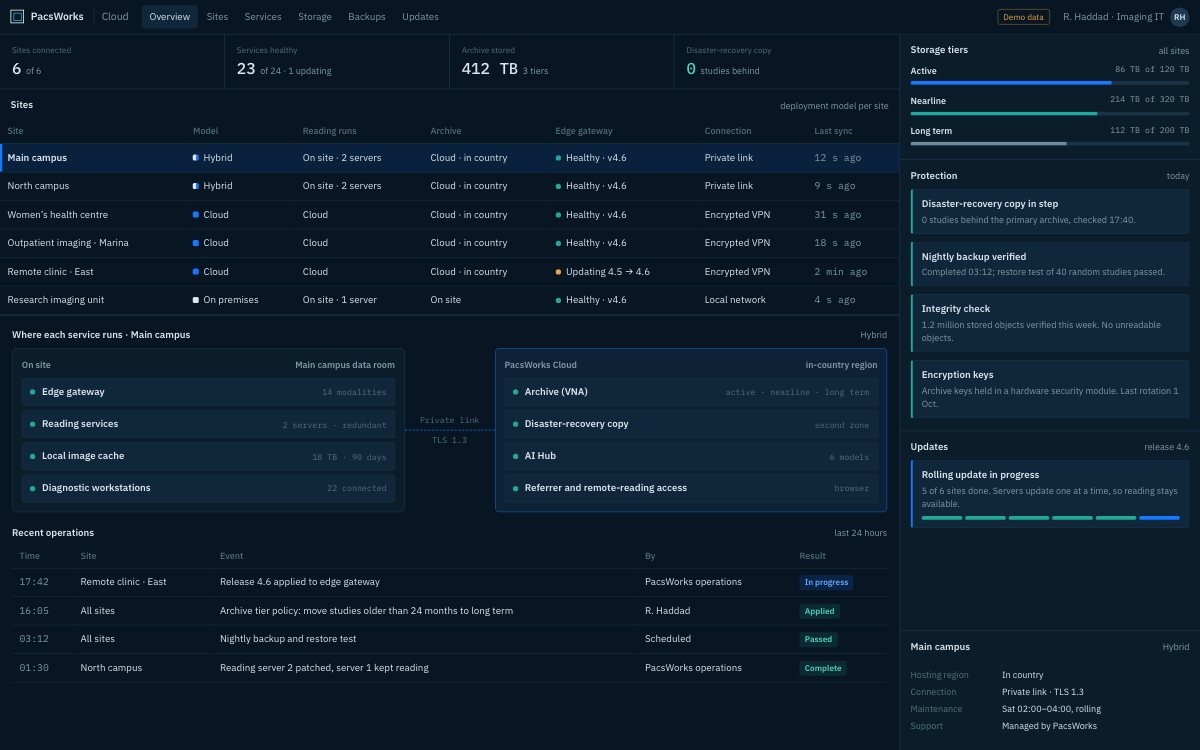
Every site in the network, its deployment model and the state of the shared archive in one console. Screens show demo data and synthetic images.
The challenge
Regional health networks and public hospital groups need imaging that can be shared across organisations, governed centrally and maintained for decades.
A regional health network is many organisations sharing patients. Someone scanned at a district hospital is treated at a tertiary centre, followed up in a clinic and reviewed by a specialist in another city, and their images need to follow them.
Each organisation has its own systems, budget cycle and IT team, and patient data is subject to residency and sovereignty rules. Programmes run for years, outlive suppliers and must keep images readable for decades.
PacsWorks provides the shared layer: archives that can be central or federated, gateways that connect each organisation through standard interfaces, and retention, access and audit policies set once for the network and applied everywhere.
How it fits together.
Organisations keep their local systems. A gateway connects each one to a network archive and exchange layer, governed by one set of policies.
A patient moving across the network.
- District hospital
Scanned
The study is acquired and stored locally as usual.
- Gateway
Registered
A copy, or an index entry, is sent to the network archive under the patient’s identifier.
- Tertiary centre
Discovered
When the patient is referred, the clinician sees the imaging history from every organisation.
- Viewer
Retrieved
Studies from other organisations open in the browser viewer next to local ones.
- Audit
Logged
Every access across organisations is recorded against the user and the purpose.
What changes.
Exchange between organisations
Share studies between hospitals and networks using DICOM, DICOMweb and IHE profiles.
Central or federated archives
Choose one central archive, or federate archives that stay with each organisation.
Large migration programmes
Plan and run multi-site migrations with reconciliation reporting for every site.
Open standards at every layer
Standards-based interfaces keep each component replaceable.
Regional deployment
Deploy within the region to meet data-residency and sovereignty requirements.
Governance and lifecycle
Retention, access and audit policies are set centrally and applied everywhere.
Standard interfaces between every organisation.
Each organisation connects through the same set of interfaces: DICOM and DICOMweb for images, HL7 and FHIR for orders, reports and patient context, and IHE profiles for exchange between organisations. Every interface and message is visible to network operations.
- DICOM, DICOMweb, HL7 v2, FHIR and IHE
- Field mapping managed centrally
- Message-level audit
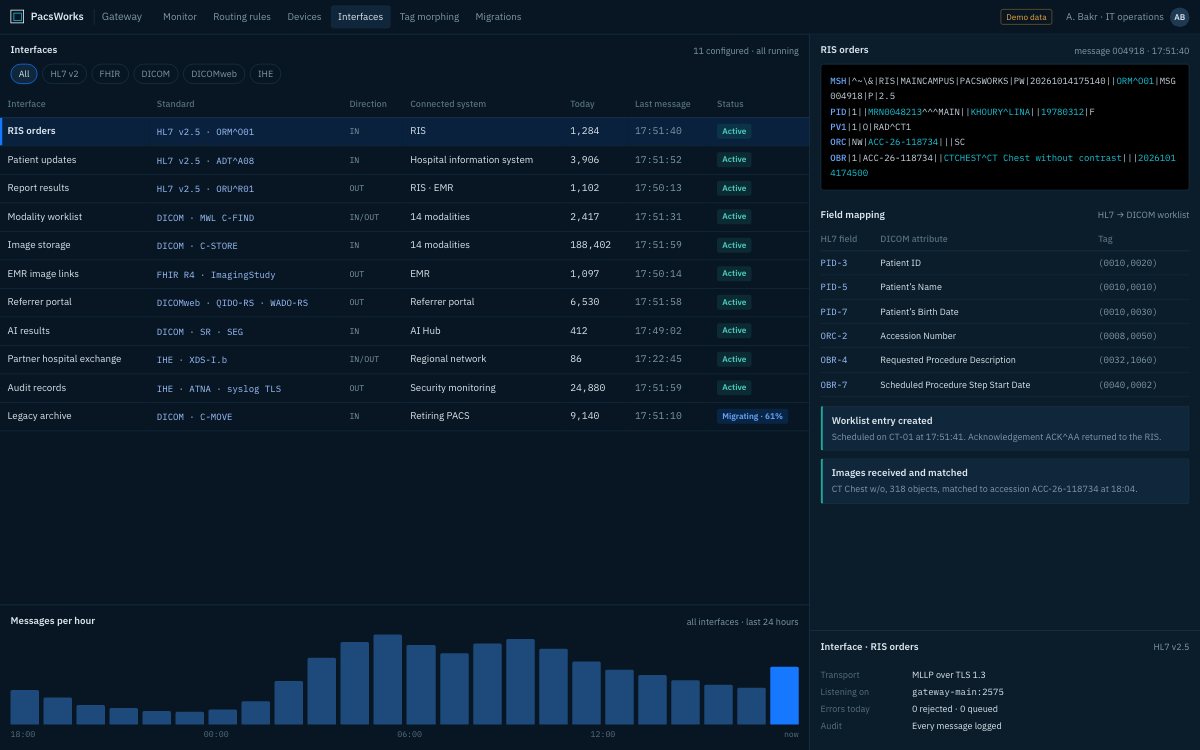
Migration programmes run site by site.
Large networks rarely move at once. Gateways at each organisation route new studies to the network archive while legacy archives are migrated in waves, with counts reconciled per site before anything is switched off.
- Waves planned per organisation
- Reconciliation report for every site
- Legacy systems available until signed off
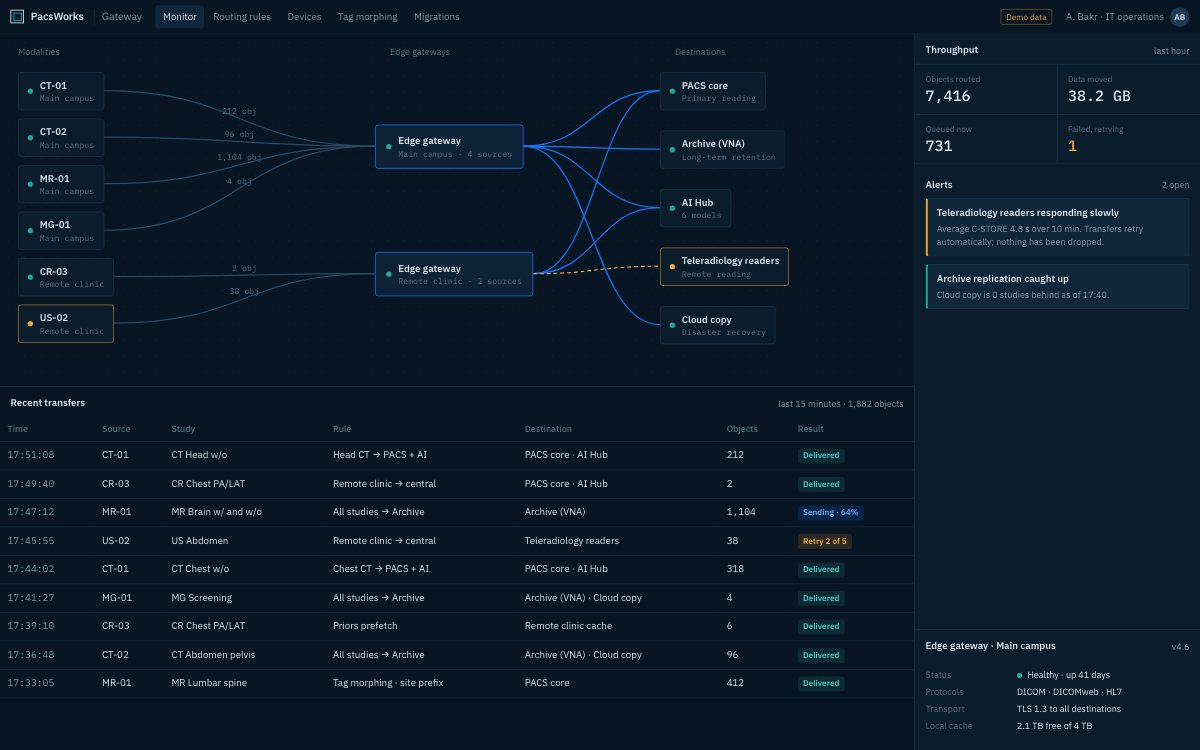
Screens show demo data and synthetic images.
What each team gets.
Network authority
One set of retention, access and audit policies, applied across every organisation.
Hospital IT teams
Standard interfaces to connect to, and local systems they can keep or replace on their own schedule.
Clinicians
A patient’s imaging history from across the network, in the browser.
Data protection officers
In-region hosting, role-based access and an audit trail of every cross-organisation access.
How a rollout is phased.
No single cut-over. Each phase runs alongside what is already in service.
Programme design
Organisations, data flows, residency requirements and the archive model (central or federated) are agreed.
Pilot region
A small group of organisations connects first and the exchange is proved end to end.
Migrate in waves
Remaining organisations connect and migrate in planned waves, each reconciled.
Govern and extend
Policies are reviewed centrally and new organisations join through the same interfaces.
Questions we hear.
Central or federated archive: which is better?
It depends on governance. A central archive is simpler to operate; a federated model keeps data with each organisation and shares an index. PacsWorks supports both, and the choice can differ by region.
Does data stay in the country?
PacsWorks is deployed within the region to meet data-residency and sovereignty requirements, including in-country hosting where health-data law requires it.
Can organisations keep their existing PACS?
Yes. Gateways connect existing systems to the network layer through standard interfaces, so each organisation can replace its local PACS on its own timeline.
How long can images be kept?
As long as policy requires. Retention rules are set per study type and organisation, and storage tiers keep long-term retention affordable.
How is access across organisations controlled?
Through role-based access tied to each organisation’s identity provider, with every cross-organisation access logged for audit.
Tell us about your imaging environment.
What you run today, where the bottlenecks are and how you expect to grow. We will come back with an architecture, not a product pitch.