On premises, in the cloud, or both.
We start from your clinical workflow, latency, resilience and data requirements, then choose where each part runs.
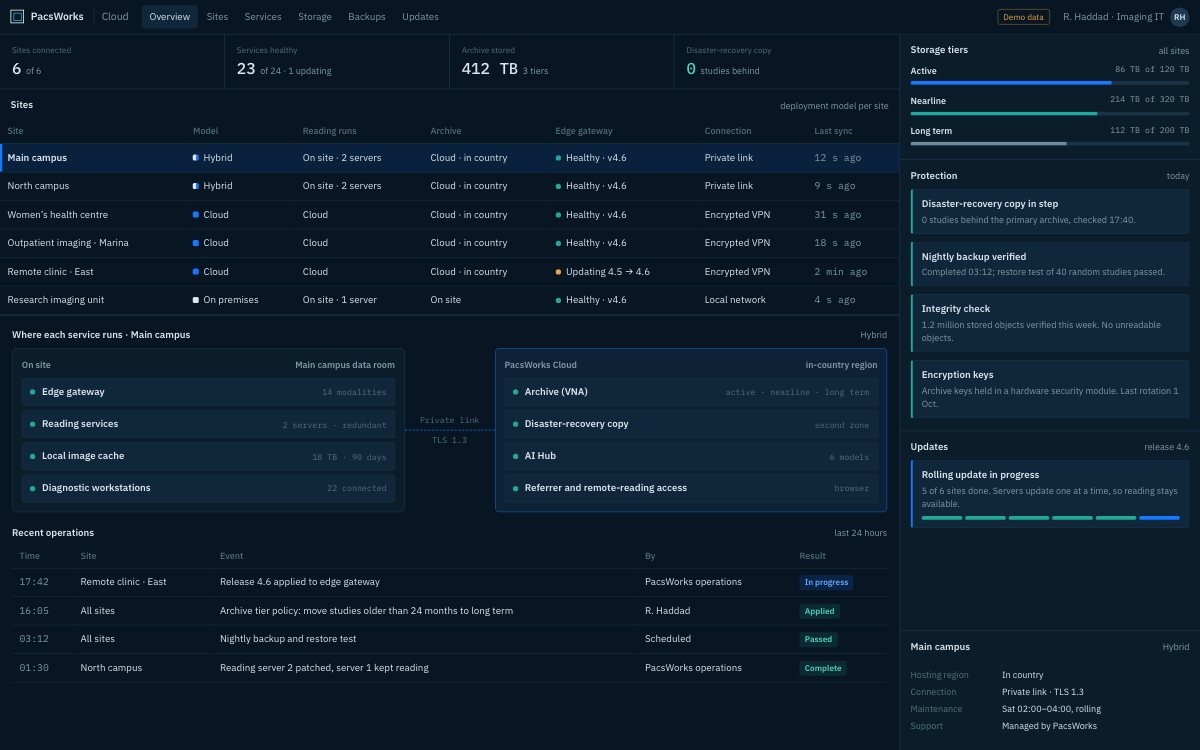
The PacsWorks Cloud console shows every site, its deployment model and where each service runs. Screens show demo data and synthetic images.
Decide per component, not per product.
Deployment is usually framed as a single choice between on premises and cloud. In practice it is a set of smaller choices: where reading happens, where the archive lives, where the recovery copy sits and where AI models run. Each has its own trade-off between speed, cost, control and resilience.
PacsWorks runs the same software in every model, so these choices can be made one component at a time and changed later. A hospital can keep reading on site for speed, put its long-term archive in the cloud to stop buying storage, and move the rest when it is ready.
We start with your workflow, your sites, your network and your regulatory constraints, and design the deployment around them.
Three models, one software.
What stays at your site and what moves to PacsWorks Cloud in each model.
On premises
Hybrid
Cloud
On premises
Every PacsWorks component runs on servers in your own data centre. Reading performance is entirely local and no imaging data leaves your network unless you send it.
A good fit when
- Policy or regulation requires all data on site
- You have a data centre and a team to run it
- Network links to the outside are limited or expensive
What stays with your IT team
- Servers, storage and virtualisation
- Backups and the disaster-recovery copy
- Network and security infrastructure
Hybrid
Reading and scanner traffic stay on site for speed, while the archive, the disaster-recovery copy, remote reading and AI move to PacsWorks Cloud. A common choice for hospitals modernising an existing estate.
A good fit when
- Local reading speed matters, but storage growth does not belong on site
- You want an off-site recovery copy without building a second data centre
- Radiologists read remotely part of the time
What stays with your IT team
- Reading servers and the local image cache
- Edge gateways and workstations
- The private link or VPN to the cloud
Cloud
PacsWorks runs fully hosted and managed in an in-country cloud region. Only scanners, workstations and a small edge gateway stay at your site.
A good fit when
- You would rather not run imaging servers at all
- Sites are spread out or growing quickly
- Storage needs are hard to predict
What stays with your IT team
- Scanners, workstations and the edge gateway
- Internet or private connectivity
- User accounts and access policy
Where each part runs.
The software is the same in every model. What changes is where each component lives.
| Component | On premises | Hybrid | Cloud |
|---|---|---|---|
| Reading and worklist | On site | On site | Cloud |
| Image archive | On site | Cloud | Cloud |
| Disaster recovery copy | On site | Cloud | Cloud |
| AI models | On site | Either | Cloud |
Who runs what.
The more that runs in PacsWorks Cloud, the more of the day-to-day operation moves to us.
| Responsibility | On premises | Hybrid | Cloud |
|---|---|---|---|
| Servers and storage hardware | Your team | Shared | PacsWorks |
| Operating system and database patching | Shared | Shared | PacsWorks |
| PacsWorks software updates | PacsWorks | PacsWorks | PacsWorks |
| Monitoring and alerting | Shared | PacsWorks | PacsWorks |
| Backup and disaster-recovery copy | Your team | Shared | PacsWorks |
| Network links between sites | Your team | Shared | Shared |
| Users, roles and access policy | Your team | Your team | Your team |
| Clinical configuration: hanging protocols, routing, retention | Shared | Shared | Shared |
A typical split. The exact division of responsibilities is agreed in each contract.
A hybrid deployment, drawn out.
Scanners, reading and workstations stay on site. The archive, recovery copy, AI and remote access sit in an in-country cloud region, connected over an encrypted link.
Resilience by design.
Reading has to continue through maintenance, hardware failure and outages. Resilience is part of the architecture in every model, not an add-on.
Redundant reading
Reading services run on more than one server, so maintenance and a single failure do not stop reading.
A separate recovery copy
The disaster-recovery copy lives on a second site or cloud zone, kept in step continuously.
Tested, not assumed
Backups are restore-tested and stored objects are verified on a schedule.
What we plan together.
The questions that decide a deployment, and how we answer them.
Network
Large CT and MR studies can run to thousands of images. We size links per site and decide what is cached locally, so reading speed does not depend on the internet connection.
Storage growth
Imaging volumes rise every year. Tiering rules decide how long studies stay on fast storage before moving to cheaper tiers.
Data residency
Health data law in the UAE and much of the region requires in-country hosting. We choose hosting regions to meet it.
Identity
Users sign in through your identity provider, so joiners, movers and leavers are handled where they already are.
Integration
RIS, EMR, scanners and other PACS are connected through standard interfaces in every model, so the deployment choice does not change them.
Workstations
Diagnostic workstations stay at your site in every model; we confirm display and hardware requirements during design.
Moving to hybrid or cloud in stages.
Modernisation does not need a single cut-over. Most organisations move in this order.
Connect sites
Edge gateways go in at each site, so scanner workflows stay stable while the back end changes.
Move the archive
Storage is tiered and legacy data migrated and validated before old systems are retired.
Add cloud services
Disaster recovery, a secondary archive or remote reading move to the cloud when they are ready.
Move reading if it suits
Reading can stay on site for good, or move to hosted services once the network and workflow are proved.
Every site and link on one screen.
Whatever the model, the gateway monitor shows every modality, edge gateway and destination, with transfers, queues and retries in real time. Problems surface on the monitor before they reach the reading room.
- Live status per site and destination
- Queues and retries visible
- Alerts for slow or failing links
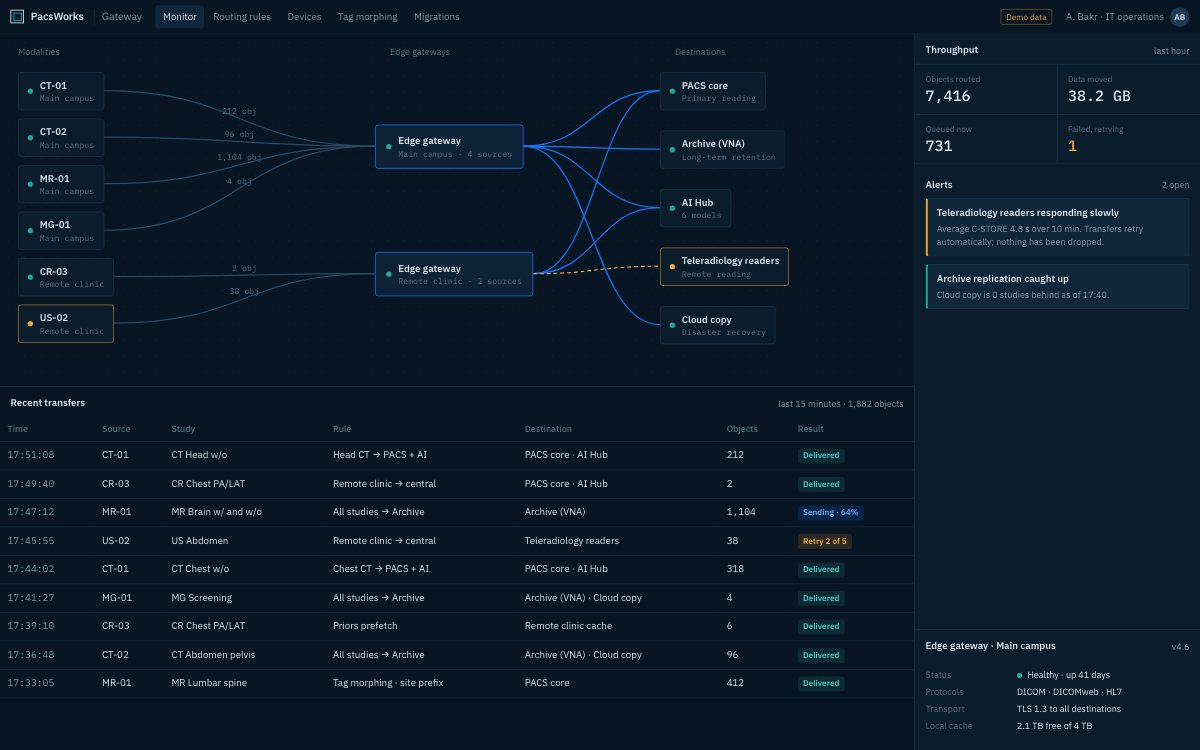
Screens show demo data and synthetic images.
Questions we hear.
Can we start on premises and move to the cloud later?
Yes. The software is the same in every model, so moving changes infrastructure, not the product your radiologists use. Most organisations move one component at a time, starting with the disaster-recovery copy or the long-term archive.
Will reading be slower in the cloud?
In the hybrid model, reading stays on site and is as fast as on premises. In the fully hosted model, the viewer streams images progressively and the edge gateway caches priors locally, so first images appear quickly even on large studies.
Where is our data hosted?
In an in-country cloud region chosen to meet your data-residency requirements. The hosting region is stated in the contract.
Who applies updates?
PacsWorks delivers and supports every software update. In hosted components we apply them, server by server, so reading stays available; on premises we plan them with your IT team.
What happens if the link to the cloud fails?
In hybrid deployments, reading continues on site from the local cache and reading servers. Studies for the cloud wait in the gateway queue and are sent when the link returns.
Tell us about your imaging environment.
What you run today, where the bottlenecks are and how you expect to grow. We will come back with an architecture, not a product pitch.